Sioux Falls sits on a deceptive substrate. The Big Sioux River carved through glacial till, leaving pockets of compressible clay and organic silts that plague foundations across the city, especially east of I-229. We’ve pulled Shelby tube samples from downtown projects where the undrained shear strength barely hits 400 psf at 12 feet. Stone column design here isn’t just a textbook exercise—it’s a direct response to the variable alluvium that makes shallow footings a gamble. Our lab runs consolidation tests on every soft layer encountered because the settlement potential near the river bends can exceed three inches under modest structural loads. Combining field data with CPT testing gives us a continuous strength profile, and when we need to verify improvement after installation we rely on plate load testing to confirm the composite modulus of the treated ground.
A properly designed stone column grid in Sioux Falls glacial lake clay can cut total settlement by half—and accelerate consolidation from years to weeks.
How we work
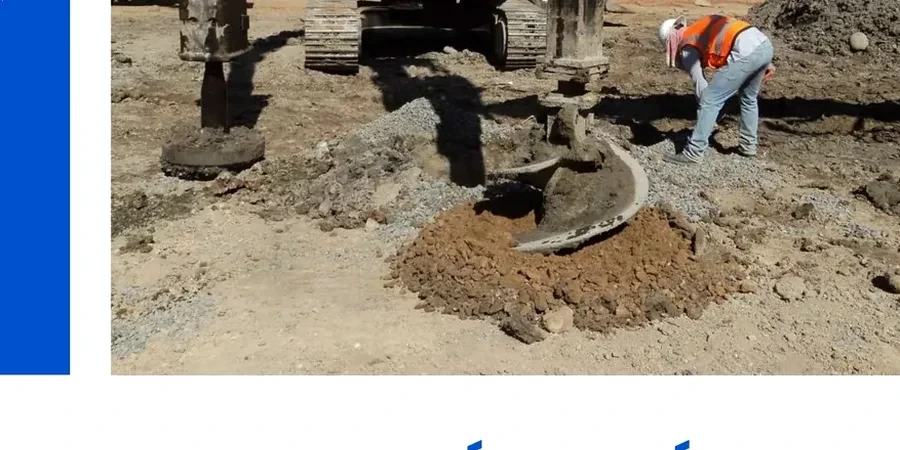
Local ground factors
Comparing two Sioux Falls neighborhoods tells the story. West of Kiwanis Avenue, near the airport, the glacial till is shallow and stone column design is straightforward—columns bear directly on dense material, and settlement is minimal. But head east toward the industrial corridor along Rice Street and the soil profile changes dramatically. Soft, compressible clay extends 20 feet or more, and groundwater sits just 6 feet below grade. Installing stone columns in that saturated clay without adequate site characterization risks bulging failure in the upper column segments. The biggest liability we see is underestimating the lateral support provided by the surrounding soil. If the undrained shear strength is below 15 kPa, the columns can’t develop full capacity, and the ground improvement becomes ineffective. We always recommend shear vane testing in the field paired with triaxial CU tests in the lab before finalizing the column spacing.
Relevant standards
IBC 2024 Chapter 18: Soils and Foundations, ASCE 7-22 Minimum Design Loads, ASTM D1586 Standard Test Method for SPT, ASTM D2487 Unified Soil Classification System, ASTM D4767 Consolidated-Undrained Triaxial Test
Other technical services
Subsurface Investigation & Sampling
Mud rotary drilling with Shelby tube sampling through the soft clay layer. We log every foot of recovery and run pocket penetrometer tests on-site to map the undrained shear strength profile before any design calculations begin.
Laboratory Consolidation & Strength Testing
One-dimensional consolidation tests (ASTM D2435) on undisturbed clay specimens to determine compression index and preconsolidation pressure. Triaxial CU tests with pore pressure measurement carry out the effective stress parameters for finite element modeling.
Gravel Source Characterization
Sieve analysis and relative density testing on the proposed stone column aggregate. We verify the grain size distribution meets the filter criteria to prevent clay intrusion into the column and maintain long-term drainage performance.
Post-Installation Verification
Plate load tests on individual columns and column groups to confirm the composite modulus of the treated ground. We compare measured settlement under load to the design predictions and adjust the acceptance criteria based on structural tolerances.
Typical parameters
Common questions
What soil conditions in Sioux Falls make stone columns the right choice?
Stone columns work best in cohesive soils with undrained shear strength between 15 and 50 kPa—exactly the range we find in the soft glacial lake clays and alluvial deposits along the Big Sioux River corridor. They’re particularly effective when the soft layer is 10 to 30 feet thick and overlies competent till. For organic silts or peat, we typically recommend alternate methods.
How much does a stone column design and testing program cost for a typical Sioux Falls commercial site?
For a standard commercial lot requiring subsurface investigation, laboratory consolidation and triaxial testing, design calculations, and post-installation plate load verification, programs typically range from US$1,600 to US$4,530 depending on the number of borings, depth of the soft layer, and testing scope required to satisfy the geotechnical engineer of record.
How long does it take to see the full settlement reduction after stone column installation?
The stone columns act as vertical drains, dramatically accelerating consolidation. In Sioux Falls clay with a coefficient of consolidation around 0.5 to 2 ft²/day, primary consolidation that would normally take 2 to 5 years can complete in 4 to 12 weeks after column installation. We monitor this with settlement plates and piezometers during the post-installation period.
What’s the difference between stone columns and vibrocompaction for Sioux Falls sites?
Vibrocompaction densifies granular soils through vibration and is effective in sands and gravels. Stone columns, by contrast, reinforce soft cohesive soils by creating stiff inclusions that share load with the surrounding clay. Most Sioux Falls sites east of the river have enough clay content that vibrocompaction alone won’t work—the cohesive nature of the soil requires the replacement and reinforcement approach that stone columns carry out.