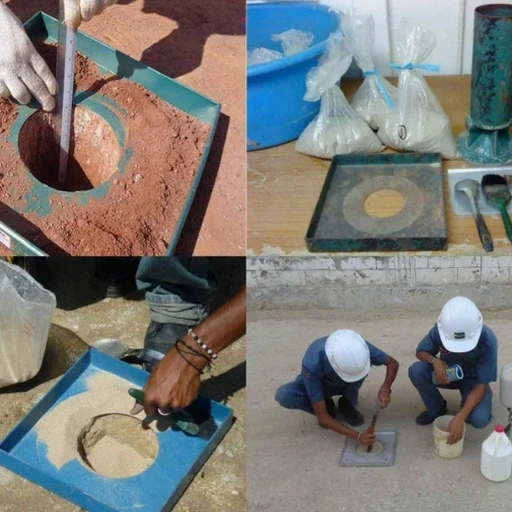
We were called out to a new warehouse site just off I-29 near Tea last August. The contractor had just finished compacting a structural fill lift over that silty clay subgrade typical of the Big Sioux River valley, and the proof roll looked clean. But the first three sand cone tests we ran told a different story — densities hovering at 92% of modified Proctor where 95% was specified. Sioux Falls has this deceptive soil profile: the top few feet of weathered loess can compact beautifully, then you hit pockets of fat clay that refuse to densify without more moisture conditioning. A plate load test can confirm the modulus if the structural engineer wants extra assurance, but the sand cone gives you the direct density number the spec requires. Our field crew works with the grading foreman right there on the lift, so adjustments happen before the next scraper pass, not after the inspector issues a stop-work order. We routinely test at sites from the industrial parks north of Benson Road down to the new residential subdivisions pushing into Lincoln County farmland.
A proof roll tells you the surface is tight — the sand cone tells you what's happening six inches down, where the footing stress actually lives.
How we work
Local ground factors
The most common mistake we see on Sioux Falls sites is taking density tests in the wrong location relative to the roller pattern. A sheep's-foot roller compacts directly under the drum, but a foot away the density can drop by three or four percent. We have watched contractors run a sand cone test right behind the roller path, get a passing number, and then the inspector walks over to the overlap zone between passes and the test fails. The difference matters. On one warehouse project near the Sioux Falls Regional Airport, the structural fill specification called for 98 percent of modified Proctor under column footings. The contractor tested only the wheel paths, and three months later we saw differential settlement across the slab. Now we insist on a random sampling plan — not just the easy spots. Another risk unique to our climate: testing too soon after rain. The Big Sioux River basin has shallow groundwater in spring, and a saturated subgrade can read artificially high density from pore water, then settle as the soil drains and consolidates. We always record the weather conditions and recent precipitation on the field data sheet. For deeper verification of fill uniformity, we sometimes recommend pairing the density testing with a CPT sounding to profile the entire compacted section without excavation.
Relevant standards
AASHTO T 191, ASTM D1556, ASTM D698 / D1557 (moisture-density relationship), ASTM D2216, IBC Chapter 18 (Soils and Foundations)
Other technical services
Standard Proctor (ASTM D698) and Modified Proctor (ASTM D1557)
We run one-point and five-point Proctor curves on your site borrow material. Sioux Falls soils often require the modified effort to achieve the 95-98% densities specified on commercial and industrial projects.
In-Place Density by Sand Cone (AASHTO T 191)
On-site testing during fill placement, trench backfill, and pavement subgrade preparation. We carry out immediate written results so the grading crew can adjust moisture or roller passes without delay.
Nuclear Gauge Correlation (ASTM D6938)
For larger earthwork operations where the contractor uses a nuclear density gauge, we perform sand cone correlations to validate the gauge calibration against the local soil types, satisfying the City of Sioux Falls and South Dakota DOT requirements.
Typical parameters
Common questions
How much does a sand cone density test cost on a Sioux Falls project?
For a standard field density test using the sand cone method in the Sioux Falls area, we typically bill between US$100 and US$140 per test station. Mobilization is separate and depends on site distance from our base. Projects with multiple lifts and large pad areas usually benefit from a day-rate arrangement rather than per-test pricing.
How many density tests does the City of Sioux Falls require on a commercial building pad?
The City of Sioux Falls building code, through IBC Chapter 18, requires a minimum of one field density test per lift per 2,500 square feet of building pad area, or a frequency specified in the project's geotechnical report. Most commercial pads under 10,000 square feet need at least three tests per lift. We coordinate directly with the project geotechnical engineer to establish a testing grid that satisfies both code minimums and the structural loading requirements.
Can you run sand cone tests in cold weather or frozen ground?
We can run field density tests in cold weather as long as the fill material itself is not frozen. Sioux Falls winters mean we often work behind the frost line — the contractor scarifies any frozen crust, brings in unfrozen borrow, and we test before the next freeze cycle. Frozen soil gives falsely high density readings and will settle in spring, so the spec always requires thawed, moisture-conditioned material at the time of compaction and testing.