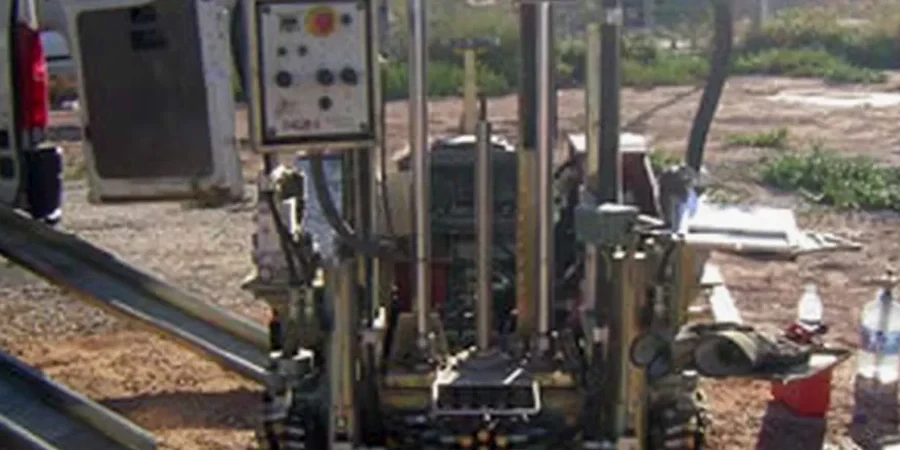
When IBC Chapter 18 and ASCE 7 require subsurface data for your Sioux Falls project, standard drilling isn't always enough. The quartzite bedrock here sits shallow—often within 20 to 50 feet—but the overlying glacial till and Big Sioux River alluvium can be tricky. That's where the cone penetration test fills the gap. A CPT rig pushes an instrumented cone into the ground at a constant rate, measuring tip resistance, sleeve friction, and pore pressure in real time. For commercial buildings near Dawley Farm Village or infrastructure along the Big Sioux, this continuous soil profile catches thin soft lenses that split-spoon samples miss. Our lab operates an accredited testing program under ISO 17025, delivering processed data within 48 hours of fieldwork. Combining CPT data with a triaxial shear test gives you drained strength parameters for foundation design on Sioux Falls collapsible silts.
A CPT log every 2 cm reveals thin sand seams in glacial till that standard SPT borings miss completely.
How we work
Local ground factors
One thing we see across Sioux Falls projects: contractors assume glacial till means uniform bearing. It doesn't. The Des Moines Lobe left behind a mix of clay, silt, sand, and gravel—sometimes in lenses only a foot thick. A thin sand seam under a footing on clay can drain pore pressure and cause differential settlement nobody predicted. CPT cone penetration testing catches these seams because pore pressure dissipation tests show exactly how fast water moves through each layer. Another local risk is liquefaction in the Missouri River floodplain deposits, though Sioux Falls sits on higher terrace gravels. The seismic hazard per the 2023 USGS map is lower than western SD, but still requires evaluation for essential facilities per IBC. Your geotechnical report needs more than standard blow counts. It needs continuous data. A CPT profile combined with liquefaction triggering analysis gives you the cyclic resistance ratio layer by layer—no guesswork.
Relevant standards
ASTM D5778 – Standard Test Method for Electronic Friction Cone and Piezocone Penetration Testing of Soils, IBC 2021 Chapter 18 – Soils and Foundations, ASCE 7-22 – Minimum Design Loads for Buildings and Other Structures, ASTM D2487 – Classification of Soils for Engineering Purposes (Unified Soil Classification System)
Other technical services
Piezocone (CPTu) with Dissipation
Full CPTu cone with pore pressure measurement at the shoulder filter. Includes dissipation tests at specified depths to estimate groundwater conditions and consolidation characteristics in Sioux Falls silty clays.
Soil Behavior Type Profiling
Automated SBT classification per Robertson (1990, 2010) from qc and friction ratio. Delivered as a color log showing sand, silt, and clay layers across the full push depth.
Typical parameters
Common questions
How much does CPT testing cost in Sioux Falls?
Mobilization and testing typically range from US$190 to US$250 per test location, depending on depth, site access, and whether you need dissipation tests. A full day with multiple pushes brings the per-location cost down. We carry out a fixed quote after reviewing the site address and planned push depths.
How deep can you push the CPT cone in Sioux Falls soils?
In the glacial till and alluvium across the Sioux Falls area, our 20-ton rig typically reaches 40 to 60 feet before encountering refusal on the Precambrian Sioux Quartzite bedrock. We'll push until refusal or the target depth, whichever comes first, and record the refusal depth on the log.
Do I still need soil borings if I run CPT tests?
CPT provides continuous stratigraphy and engineering parameters, but it doesn't retrieve a physical sample. For environmental screening, visual classification, or select lab tests like Atterberg limits, you'll still want at least one boring to ground-truth the CPT soil behavior type. Most Sioux Falls jobs combine one boring with three to five CPT pushes.