A few winters ago we got called out to a mixed-use project near the Big Sioux River where a deep excavation for underground parking kept creeping inward. The contractor had soldier piles in place but underestimated the lateral squeeze from saturated glacial till once the frost came out of the ground. That job taught a lot of people in Sioux Falls something important: anchors aren't just steel tendons you tension and forget. The difference between an active anchor pre-loaded to control movement and a passive anchor that only engages once soil deforms can make or break your shoring wall. With the water table sitting fairly high across much of the valley and bedrock anywhere from 15 to 50 feet down depending on whether you're east or west of I-29, anchor bond length has to be tuned to the geology, not copied from a spec sheet. When we design an anchor system here, we're thinking about winter construction windows, the stiff oxidized clays that look great in a hand sample but lose bond strength when remolded, and the reality that a retaining wall tieback failing even a few inches can rack the steel framing above grade.
An anchor that hasn't been lift-off tested in Sioux Falls till is just a hope with a steel tendon attached.
How we work
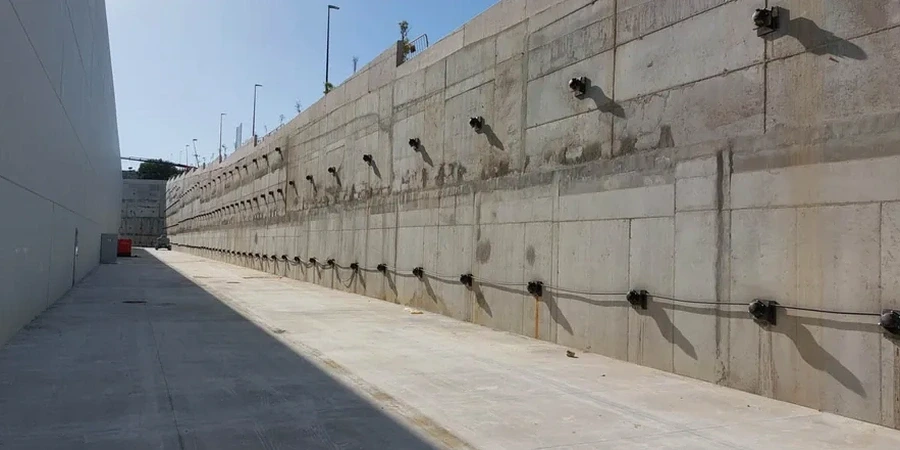
Local ground factors
Sioux Falls sits in a weird middle ground climatically — not cold enough for permafrost engineering, but cold enough that our frost line reaches 48 inches and stays there for weeks. That means anchor heads near the surface, especially for temporary shoring that stays in place over winter, see freeze-jacking if water gets into the trumpet and expands. We've measured 3/8 inch of upward movement on waler beams in February that didn't exist in November. The bigger risk is on the geology side. The glacial till here is overconsolidated from the weight of ice that's been gone for ten thousand years — it has real cohesion, but it's also fissured. Water moves through those fissures, softening the clay at the bond zone over time. A passive anchor installed without a thorough understanding of this secondary permeability can pass a short-term test and still lose 30% of its capacity within two wet seasons. This is why we insist on slope stability analysis that couples the anchored wall behavior with the broader site hydrology, not just a 2D cross-section with assumed pore pressures.
Relevant standards
PTI DC35.1-14: Recommendations for Prestressed Rock and Soil Anchors, IBC 2024 Chapter 18: Soils and Foundations (anchor testing provisions), ASCE 7-22 Section 4.12: Earth Pressure and Anchor Load Combinations, ASTM A416/A416M: Standard Specification for Low-Relaxation, Seven-Wire Steel Strand for Prestressed Concrete (anchor tendons), FHWA NHI-10-016: Ground Anchors and Anchored Systems
Other technical services
Tieback Anchors for Deep Excavations
Active (prestressed) anchors designed for multi-level parking basements and cut-and-cover utility vaults in downtown Sioux Falls. Loads typically range from 60 to 200 kips depending on wall height and soil conditions. We specify lift-off testing procedures and lock-off loads, and we'll review the contractor's stressing sequence to avoid overloading the walers.
Permanent Anchors for Retaining Structures
Fully encapsulated passive or active anchors for cast-in-place retaining walls, bridge abutments, and shoreline stabilization along the Big Sioux River. Double corrosion protection is standard. We calculate long-term creep potential in the overconsolidated till and specify acceptance criteria aligned with PTI recommendations for permanent applications.
Anchor Capacity Verification and Forensic Review
Proof testing, extended creep tests, and forensic evaluation of underperforming anchors. We've diagnosed everything from grout loss into sand seams to bond failure from drilling methods that smeared the till. Our reports include lift-off data interpretation and, where needed, redesigned anchor geometry for the remaining wall length.
Typical parameters
Common questions
What's the practical difference between an active and a passive anchor for my Sioux Falls project?
An active anchor is tensioned against the wall during installation, so it immediately restrains soil movement. That's what you want next to an existing building where even an inch of deflection can cause cracking. A passive anchor doesn't get tensioned — it only starts working once the soil mass deforms enough to engage it. In Sioux Falls' stiff till, that deformation might be acceptable for a temporary excavation in an open lot, but we generally recommend active anchors for any urban site with adjacent structures or utilities.
How deep do you need to go to find good bond material in Minnehaha County?
It varies block by block. In the river valley and the southern part of the city, we often see 20 to 35 feet of overconsolidated glacial till overlying Sioux Quartzite bedrock — the till itself can carry out excellent bond if it's not fissured. West of I-29, the till is thicker and you might never hit rock in a 40-foot anchor. That's why we rely on CPT data to identify the most competent layer within a reasonable anchor length rather than assuming rock is the only solution.
What does active/passive anchor design typically cost?
For a project in Sioux Falls, anchor design packages — including bond length calculations, corrosion protection specification, testing procedures, and construction-phase review — generally range from US$980 for a straightforward temporary shoring design to US$3,420 for a permanent multi-row anchored wall requiring extended creep analysis and multiple load cases. Variables include the number of anchor rows, whether it's a temporary or permanent application, and the complexity of the subsurface profile.
Do you handle the anchor testing as well, or just the design?
We can do both. Our team writes the performance and proof testing specification as part of the design package, and we regularly go out to observe the lift-off tests and extended creep tests to verify that the installed anchors are meeting the acceptance criteria we set. If you already have a testing firm on site, we'll coordinate with them to make sure the test procedures match the design intent.