The IBC and ASCE 7 standards set a high bar for slope stability analysis, and for good reason in Sioux Falls. The city’s landscape isn’t just flat plains; it’s defined by the dramatic incision of the Big Sioux River, creating steep bluffs and terraces composed of layered glacial till and wind-deposited loess. These formations are inherently variable, and a design that works perfectly on the east side of town can face completely different conditions a mile west where the subsurface hydrology shifts. Our team tackles this head-on, combining ASTM-standardized field data with an intimate understanding of local geology to deliver slope stability analysis that protects your project from the ground up, whether you’re developing a commercial lot near Falls Park or expanding residential infrastructure along the river valley.
In Sioux Falls, the difference between a stable slope and a costly failure often comes down to understanding the perched groundwater tables hidden within the glacial till.
How we work
Local ground factors
The freeze-thaw cycles that characterize a Sioux Falls winter are a silent killer of slope integrity. Unlike the more predictable geology of the Black Hills, our local loess and glacial till are highly susceptible to a phenomenon where repeated freezing and thawing at the slope face causes a progressive loss of soil suction and cohesive strength. This isn’t a dramatic, sudden event like a California landslide; it’s a gradual, creeping movement that can go unnoticed for months until a shallow planar slip manifests after a heavy spring rain saturates the already weakened surface layer. A standard desktop study or a quick inspection misses this entirely. Our slope stability analysis explicitly models this seasonal strength degradation by testing remolded samples at their residual strength, ensuring the design remains stable not just on paper in August, but through the critical saturation period of April and May when most slope failures occur in Minnehaha County.
Relevant standards
IBC 2021 – Section 1806: Presumptive Load-bearing Values and Slope Stability, ASCE 7-22 – Chapter 11: Seismic Design Criteria for Slopes, ASTM D1586 – Standard Penetration Test (SPT), ASTM D2487 – Unified Soil Classification System (USCS), ASTM D4767 – Consolidated Undrained Triaxial Compression Test
Other technical services
Global Stability Modeling
We construct detailed 2D and 3D models using limit equilibrium and finite element methods to calculate the factor of safety for deep-seated rotational failures common in the thick glacial till deposits of the Sioux Falls area.
Seismic Slope Deformation
Using the pseudostatic approach from ASCE 7-22 and site-specific ground motion data, we evaluate the potential for seismically-induced permanent displacements on critical embankments and cut slopes.
Remedial Design Support
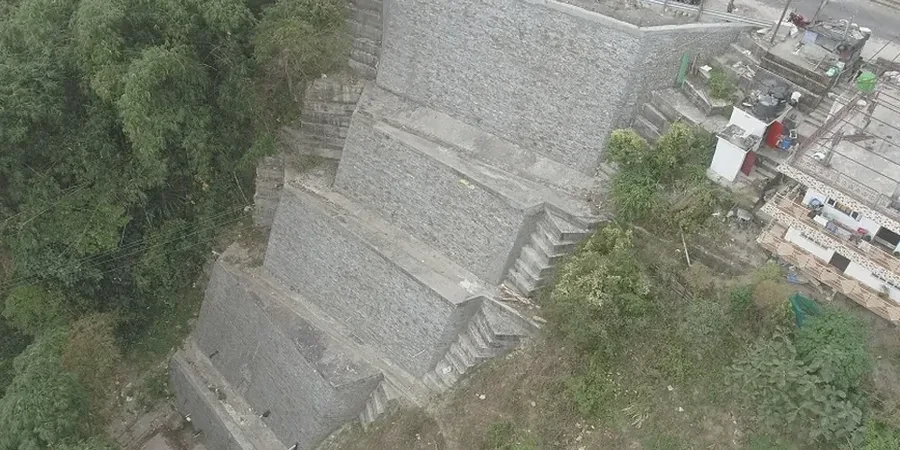
When an existing slope shows signs of distress, we carry out the geotechnical parameters needed to design fixes like soil nailing, mechanically stabilized earth (MSE) walls, or targeted dewatering systems to restore long-term stability.
Typical parameters
Common questions
When is a slope stability analysis required for a building permit in Sioux Falls?
Sioux Falls enforces the IBC, which requires a slope stability analysis when structures are placed on slopes steeper than 1 unit vertical in 3 units horizontal (33%) or when the slope height exceeds 10 feet. Given our river bluffs, this triggers the requirement for most developments along the Big Sioux River corridor, especially where existing fill or cut operations are planned.
What is the typical cost range for a commercial slope stability analysis here?
For a commercial project in Sioux Falls requiring a full analysis with supplemental lab testing, you can expect a range from US$1,410 for a straightforward, single-section evaluation to US$4,520 for a complex, multi-slope model with seismic analysis and remediation recommendations. The scope depends heavily on the stratigraphy and the amount of undisturbed sampling required.
How do you account for the loess soil conditions found on the west side of Sioux Falls?
Loess presents a unique challenge because it stands nearly vertical when dry but collapses rapidly when saturated. Our analysis focuses heavily on the collapsible potential and the loss of matric suction. We run saturated triaxial tests to find the fully-softened strength envelope, which is often the controlling case for shallow slope failures in these wind-blown silt deposits.
Can you analyze an existing slope that is showing cracks or movement?
Absolutely. For distressed slopes, we perform a forensic geotechnical evaluation. This involves a site reconnaissance to map the crack patterns, a drilling program to confirm the failure plane depth, and a back-analysis of the slope to determine the in-situ shear strength at the time of failure. This back-calculated value becomes the target for the remedial design to restore an acceptable factor of safety. More info.