The elastomeric bearing sets arrive on a flatbed, each unit weighing over two tons. Our crew positions them on the pedestals below the basement slab; these are the isolation interfaces that decouple a building from the ground. In Sioux Falls we work with lead-rubber and high-damping rubber bearings sized for the stiff glacial till overlying the Sioux Quartzite. The city sits in Seismic Design Category B per ASCE 7-22, but the long-period motion that travels through the Midcontinent craton can surprise you. A moderate event near the New Madrid zone or the Humboldt Fault generates low-frequency waves that travel efficiently through the old basement rock. We tune the isolation period to 2.5–3.0 seconds, pushing the structure above the dominant ground period. For critical projects near Avera McKennan or Sanford USD Medical Center, we combine isolation with a seismic microzonation study to capture site-specific spectra before finalizing bearing dimensions.
A properly tuned isolation system cuts lateral forces by a factor of three to four compared to a fixed-base design in Sioux Falls soil conditions.
How we work
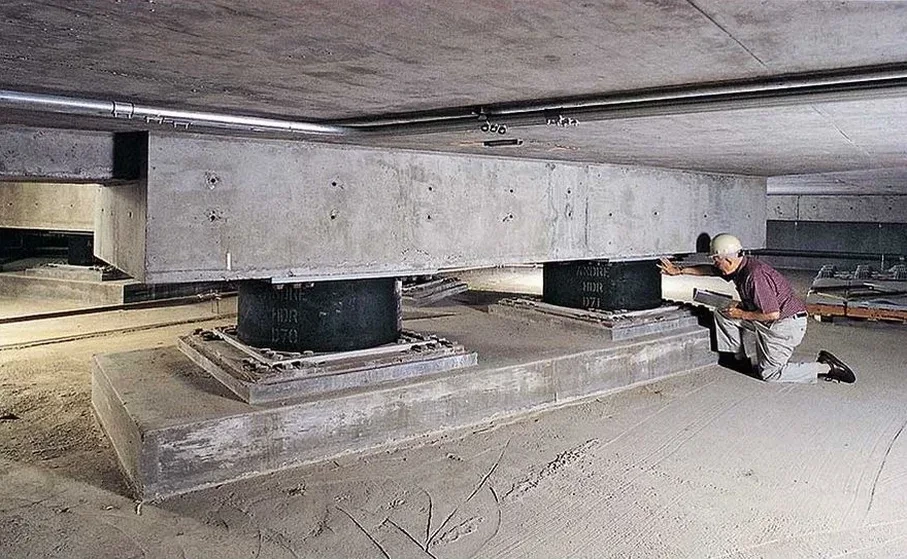
Local ground factors
The winter freeze-thaw cycles in Sioux Falls penetrate three to four feet into the clay, and that seasonal heave can tilt a fixed-base foundation enough to crack shear walls. With an isolation plane, the superstructure moves as a rigid block above the bearings, so differential heave in the foundation below does not transmit the same distortion upward. The bigger concern here is the long-period energy from distant events. A magnitude 7.0 on the New Madrid fault, 600 miles southeast, generates 1–2-second spectral acceleration that matches the resonant frequency of a 5–10-story building. That is precisely the range where fixed-base structures accumulate drift. Isolation shifts the building period out of that danger zone. We design the moat covers and utility connections for the full maximum considered earthquake displacement, plus a margin for torsional rotation, because the quartzite contact can create a sharp stiffness contrast that amplifies rocking modes.
Relevant standards
ASCE 7-22 Minimum Design Loads, IBC 2021 Chapter 17 (Seismic Isolation), ASTM D4014 Standard Specification for Plain and Steel-Laminated Elastomeric Bearings
Other technical services
Isolation system feasibility and conceptual design
We compare fixed-base and isolated schemes during schematic design. Deliverables include preliminary bearing sizes, isolation period targets, and a cost–benefit summary based on reduced structural tonnage and damage expectations.
Nonlinear time-history analysis and bearing specification
Using site-specific ground motion suites matched to the ASCE 7 target spectrum, we model the isolation system in 3D with bilinear hysteresis elements. Output includes bearing schedules, displacement demands, and wind-restraint verification.
Peer review and construction-phase testing
We prepare calculation packages for independent review and supervise prototype bearing tests per ASTM D4014. During installation we verify leveling tolerances and witness the compression and lateral shear acceptance tests.
Typical parameters
Common questions
What does base isolation design cost for a project in Sioux Falls?
For a mid-rise building in the Sioux Falls area, the isolation system design fee typically ranges from US$4,640 to US$8,960. The final number depends on the number of isolators, the complexity of the nonlinear time-history analysis, and whether a peer review panel is required by the jurisdiction. Bearings themselves are a separate procurement cost.
Does Sioux Falls require seismic isolation under the IBC?
The IBC 2021 does not mandate isolation for any specific building in Sioux Falls. It becomes a design choice when the owner wants enhanced performance, reduced structural member sizes, or operational continuity after an earthquake. Hospitals and data centers are the most common candidates in Minnehaha County.
How do you verify the soil conditions for the isolation pedestals?
We drill SPT borings to refusal at each pedestal location, logging the glacial till consistency and the depth to the Sioux Quartzite. Where rock is shallow we run seismic refraction lines to confirm the top-of-rock profile and identify any weathered seams that could cause differential settlement under the bearing pads.
What happens to the utilities that cross the isolation plane?
Every pipe and conduit crossing the isolation interface must accommodate the full design displacement in three directions. We specify flexible couplings, loops, or articulated joints rated for the maximum considered earthquake displacement plus an additional 30% for torsional effects. Gas lines get automatic shut-off valves triggered by seismic sensors.