Sioux Falls sits on a shallow Precambrian Sioux Quartzite basement that can rise to within 10 feet of the surface downtown, but drops to over 100 feet deep just a few miles east where glacial till and outwash sands dominate. That abrupt transition makes foundation design unpredictable without subsurface imaging. Our team runs vertical electrical sounding surveys to map the quartzite contact continuously, avoiding the blind spots that isolated borings leave. We combine multi-electrode resistivity lines with direct CPT testing where the till is thick enough to push through, and we correlate resistivity breaks with SPT drilling logs so the stratigraphy ties back to physical samples. For commercial projects along the Big Sioux River corridor, the method also picks up paleochannels filled with compressible organic silt that standard exploration programs often miss.
Resistivity contrasts between saturated glacial till and Sioux Quartzite routinely exceed 10:1 in Sioux Falls, making VES a decisive tool for mapping bedrock topography.
How we work
Local ground factors
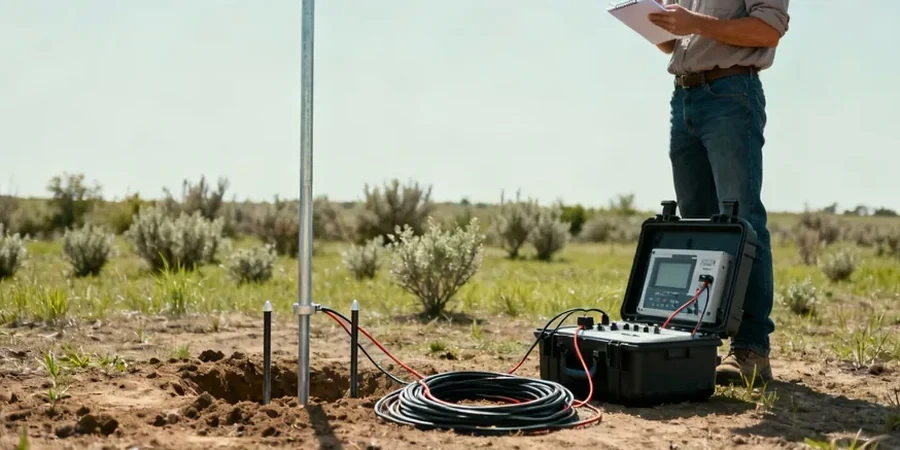
The Syscal Pro system we deploy around Sioux Falls injects up to 250 watts through stainless-steel electrodes, and on dry summer days when the topsoil resistance at the surface jumps above 2,000 ohm, we pre-wet electrode stations with saline solution to keep contact resistance below 5 kΩ. Skipping that step produces noisy pseudosections that can hide a thin silt lens sitting right above the quartzite—exactly the kind of soft seam that causes differential settlement under a mat foundation. We also monitor the battery charge level continuously because voltage drop during a long dipole-dipole scan distorts the deeper apparent-resistivity readings. When a survey runs within 200 feet of overhead transmission lines near the Brandon substation, we switch to a lower-frequency injection cycle and notch-filter the 60 Hz noise during post-processing so the telluric interference does not corrupt the inversion model.
Relevant standards
ASTM D6431-18 (Standard Guide for Using the DC Resistivity Method), ASTM D5777-18 (Standard Guide for Using the Seismic Refraction Method — referenced for complementary geophysical correlation), ASCE 7-22 (Minimum Design Loads for Buildings and Other Structures — referenced for site classification inputs), IBC 2021 (International Building Code — referenced for geotechnical investigation scope requirements)
Other technical services
2D Electrical Resistivity Tomography
Multi-electrode profiles across proposed building pads or pipeline alignments, processed with RES2DINV to produce continuous cross-sections showing till units, sand lenses, and quartzite surface. Used routinely along the Louise Avenue commercial corridor where fill thickness varies sharply.
1D Vertical Electrical Sounding
Quick depth-to-bedrock determinations using expanding Schlumberger spreads at individual footing locations. The small footprint works well in confined spaces between existing structures downtown, and the interpreted layer curves are calibrated against nearby boring logs for defensible results.
Typical parameters
Common questions
How deep can VES investigate in the Sioux Falls area?
With a 400-foot Schlumberger spread we typically resolve layers down to about 120 feet in the glacial drift. The practical limit depends on the resistivity contrast: where saturated clay overlies dry quartzite the signal penetrates well, but a thick dry sand unit above the bedrock can reduce depth penetration somewhat.
What does an electrical resistivity survey cost for a typical commercial lot?
For a standard commercial lot survey in Sioux Falls, project budgets generally fall between US$590 and US$1,170 depending on the line length, number of electrode stations, and whether 1D soundings or a full 2D tomography run is required.
Can resistivity testing distinguish sand from clay in glacial soils?
Yes, and that is exactly where the method adds value. Clean outwash sands in the Sioux Falls area typically read above 150 ohm·m while the surrounding clay till reads between 15 and 40 ohm·m. The sharp contrast lets us map sand channel geometry across a site, which matters for drainage design and for assessing liquefaction susceptibility under seismic loading.
How long does a field survey take and what access is needed?
A single 400-foot spread with 40 electrodes takes our two-person crew roughly two to three hours including setup, data acquisition with automatic stacking, and breakdown. We need a clear strip about 10 feet wide along the survey line, but the electrodes only penetrate a few inches so asphalt, gravel, and grass are all workable surfaces.