Sioux Falls sits at an elevation of roughly 1,470 feet, where the Big Sioux River has spent millennia cutting through quartzite bedrock and depositing layers of alluvial silt, sand, and clay. The city’s growth—now surpassing 210,000 residents—pushes development into areas where the subsurface profile can shift from dense glacial till to soft floodplain deposits within a single lot. The Standard Penetration Test, performed to ASTM D1586, remains the backbone of site characterization here. A split-spoon sampler is driven 18 inches into the borehole at specific depth intervals; the blow count recorded for the final 12 inches gives the N-value that engineers use to estimate relative density, friction angle, and bearing capacity. For projects near the river or in the expanding southeastern corridor, this data is non-negotiable. We often pair the SPT program with grain size analysis to confirm the fines content in the alluvial deposits, which directly influences the liquefaction susceptibility assessment under ASCE 7-22 criteria.
In Sioux Falls, an uncorrected N-value of 50 near the quartzite outcrop means something entirely different than the same blow count in a desiccated glacial clay crust—context separates a competent bearing layer from a misleading stiff crust.
How we work
Local ground factors
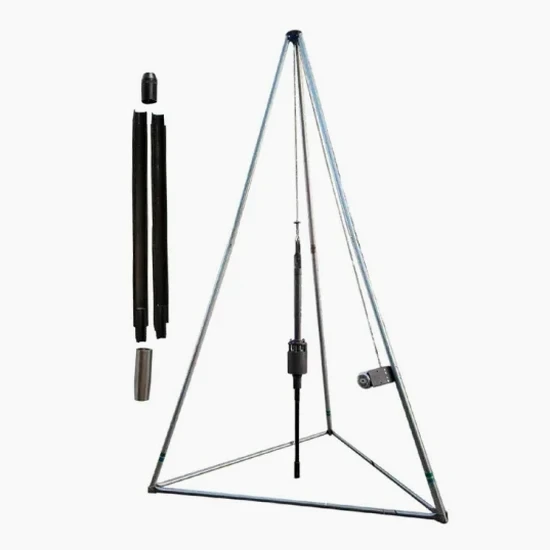
The CME-55 drill rig with an automatic SPT hammer system becomes the centerpiece of a Sioux Falls exploration program, particularly when working within the noise-sensitive downtown core or the residential neighborhoods south of 57th Street. A common operational pitfall in the region involves the transition zone between the weathered quartzite and the overlying glacial till: if the driller fails to reduce the hammer drop rate when encountering a boulder, the energy transfer spikes and yields an artificially high N-value that could mask a void or softer seam beneath. Our field technicians log the split-spoon recovery in real time, noting any grinding sounds, sudden rod drops, or water loss that signals a fracture in the underlying Sioux Quartzite. In the Big Sioux floodplain, artesian conditions occasionally appear below 25 feet; the borehole must be carefully grouted after completion to prevent vertical migration of groundwater between aquifers, a requirement enforced by the South Dakota Department of Agriculture and Natural Resources.
Video resource
Relevant standards
ASTM D1586-18: Standard Test Method for Standard Penetration Test (SPT) and Split-Barrel Sampling of Soils, ASTM D2487-17: Standard Practice for Classification of Soils for Engineering Purposes (Unified Soil Classification System), ASCE 7-22: Minimum Design Loads and Associated Criteria for Buildings and Other Structures (Chapter 20 – Site Classification), IBC 2021: International Building Code (Section 1613 – Earthquake Loads, Site Class Determination), ASTM D4633-16: Standard Test Method for Energy Measurement for Dynamic Penetrometers
Other technical services
SPT with Laboratory Testing Package
Every split-spoon sample undergoes visual classification by a staff geologist, with select samples sent to our AASHTO-accredited lab for moisture content, Atterberg limits, and sieve analysis—producing a full soil profile tied to borehole depth.
Liquefaction Screening and Triggering Analysis
Using the corrected N1,60 values, we run simplified procedures (Seed & Idriss) to evaluate liquefaction potential in the saturated sands beneath the Big Sioux River corridor, reporting factor of safety and post-liquefaction settlement estimates.
Deep Foundation Design Parameters
For sites where SPT refusal occurs on quartzite at 15 to 25 feet, we carry out unit skin friction and end-bearing values for driven H-piles or drilled shafts, calibrated to the local geology of Minnehaha County.
Typical parameters
Common questions
How many SPT boreholes does Sioux Falls require for a standard commercial lot?
Most municipal plan reviewers follow the IBC Table 1803.1, which calls for at least one boring per 2,500 square feet of building footprint for structures up to three stories. In practice, a 10,000-square-foot commercial slab on Sioux Falls’ east side typically triggers four borings, extending to at least 30 feet or refusal on quartzite. The City of Sioux Falls Building operations Division may request additional borings if the site lies within the Big Sioux River floodway overlay district.
What does an SPT investigation cost for a residential lot in Sioux Falls?
For a single-family residential parcel in Minnehaha or Lincoln County, a two-borehole SPT program with a summary letter typically runs between US$600 and US$740 per borehole, including mobilization within the Sioux Falls metro area. The final cost depends on access conditions, depth to refusal, and whether laboratory testing beyond visual classification is required.
Can SPT blow counts distinguish between the glacial till and the weathered quartzite in the field?
Yes, with expertise. The glacial till in the Sioux Falls area—typically a gray, silty clay with gravel and cobbles—will show N-values climbing from 15 to 40 as the matrix densifies near the bedrock contact. Once the split spoon hits the Sioux Quartzite, the blow count jumps to refusal (50 blows in less than 6 inches of penetration), and the driller will hear a distinct ringing tone through the rods. Our field logs note the exact depth of this transition because the weathered upper few inches of quartzite can still fracture under the hammer, producing a brief interval of moderate N-values before competent rock is reached.