The 2021 IBC Chapter 18 and ASCE 7-22 set the baseline, but deep excavation design in Sioux Falls demands more than code compliance. The city sits on a complex stratigraphy of stiff glacial till overlying Sioux Quartzite bedrock, cut by the Big Sioux River valley. Groundwater is often perched within the till at depths ranging from 8 to 20 feet, turning open cuts into dewatering challenges. For excavations exceeding 15 feet, lateral earth pressures shift dramatically between the western uplands and the river terrace deposits. A standard active pressure coefficient of 0.33 often underestimates loads when backfill consists of saturated, overconsolidated till. We integrate site-specific CPT testing to refine stratigraphic boundaries and pore pressure profiles before any shoring design begins. The quartzite bedrock, while exceptionally strong at over 15,000 psi UCS, contains near-vertical joint sets that can destabilize unsupported faces if excavation alignment parallels the regional fracture trend.
Sioux Quartzite joint orientation dictates excavation face stability more than intact rock strength. A 5-degree alignment error can triple the required support pressure.
How we work
Local ground factors
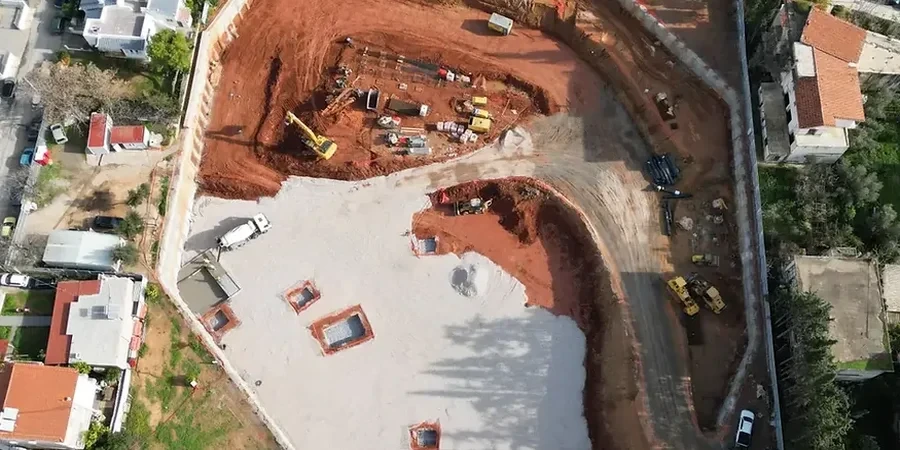
A Link-Belt 250-ton crane with a vibratory hammer drives the first soldier piles at the site perimeter. The hammer sends low-frequency vibrations through the till, which in downtown Sioux Falls can trigger settlement of older brick buildings within a 60-foot radius. We set vibration monitors at four corners of the excavation before the first pile goes in. The bigger risk is basal heave. When the excavation base is underlain by a confined sand layer with artesian pressure, the factor of safety against blowout drops below 1.2 unless we install relief wells immediately. In 2019, a site near 41st Street required emergency dewatering after a sand boil appeared at the subgrade. We now specify pore pressure transducers in all borings deeper than 1.5 times the excavation depth. Instrumentation is not optional here.
Video resource
Relevant standards
IBC 2021 Chapter 18, ASCE 7-22 Chapter 12, ASTM D1586 (SPT), ASTM D2487 (USCS), OSHA 1926 Subpart P
Other technical services
Shoring and Bracing Design
Tied-back soldier pile walls, secant piles for groundwater cutoff, and internal bracing systems analyzed with finite element methods to limit deformation under surcharge from adjacent structures.
Dewatering and Groundwater Control
Wellpoint systems, deep wells, and eductor designs for the perched aquifers common in Sioux Falls. We model steady-state drawdown and assess the radius of influence to prevent off-site settlement.
Typical parameters
Common questions
What is the typical cost range for deep excavation design in Sioux Falls?
Design fees for a deep excavation project in Sioux Falls generally range from US$2,010 to US$8,910, depending on excavation depth, shoring complexity, and the extent of the instrumentation plan required.
How does the Sioux Quartzite affect excavation sequencing?
The quartzite is extremely hard but jointed. We typically specify a pre-split blasting or expansive grout for the upper 3 to 5 feet, followed by mechanical scaling. Shoring elements must be socketed a minimum of 4 feet into competent rock, and the socket bond stress is verified against the Rock Quality Designation from core logs.
What geotechnical investigation is required before shoring design?
For excavations deeper than 15 feet, we require borings spaced no more than 50 feet apart along the wall alignment, with at least one boring extending 2 times the excavation depth below the subgrade. Each boring must include SPT N-values, thin-wall tube samples, and piezometer installation per ASTM D1586 and D2487 standards.