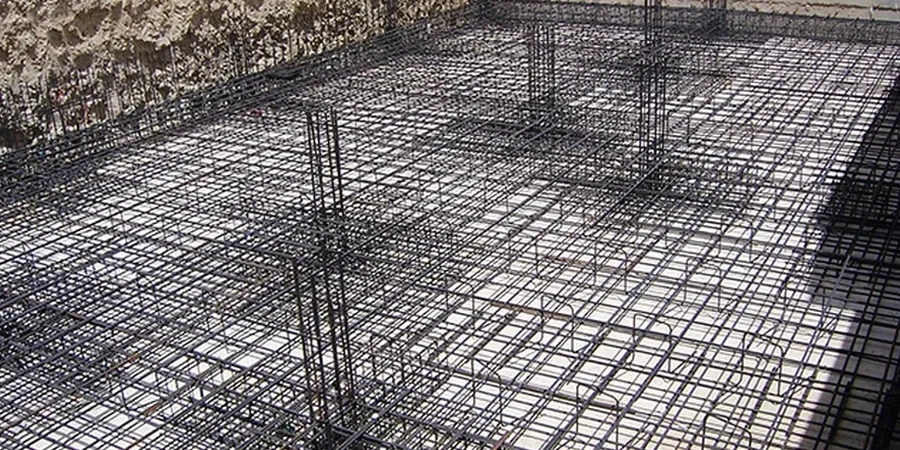
The first thing you notice on a large commercial site in Sioux Falls is the drilling rig. A truck-mounted CME-75 with hollow-stem augers, running continuous flight augers down through the dark topsoil into the glacial till that defines this region. The rig's operator watches the cuttings come up. At about 12 feet, the material shifts from lean clay to a much denser silty clay with gravel—classic Sioux Quartzite-derived till. That transition zone is where a raft foundation earns its purpose. Instead of wrestling with highly variable bearing strata under individual footings, the structural engineer stiffens the entire footprint into a single reinforced concrete mat. The rig finishes the borings, the samples go to the lab, and the conversation turns to modulus of subgrade reaction. In eastern South Dakota, where winter frost can push three and a half feet deep and summer rain saturates the fat clays along the Big Sioux River, raft design is as much about regional geology as it is about structural load paths. We combine local drilling data with the test pits program when near-surface stratigraphy needs visual confirmation.
A raft foundation in Sioux Falls doesn't just distribute load—it bridges the unpredictable moisture cycles of glacial clays that can swell 8 percent between dry autumn and wet spring.
How we work
Local ground factors
One pattern we see repeatedly in Sioux Falls is differential heave on additions built next to existing slabs. The original structure may have been placed on cut, while the addition sits on fill over a wet pocket of glacial clay. Even a modest seasonal moisture change in these expansive clays—which can swell up to 8 percent by volume—generates enough uplift to crack a lightly reinforced mat. A second, less obvious risk is frost jacking at the perimeter. When a mat foundation lacks adequate edge insulation or a deep enough frost-protected skirt, the freeze front migrates underneath and lifts the corners unevenly. We have measured quarter-inch differentials just from a single winter cycle. The IBC Table 1809.5 provides presumptive bearing values, but presumptive numbers do not account for the swelling potential of the local soils mapped by the USDA as Egan-Ethan-Tetonka complexes. A properly scoped site investigation, with enough borings to capture lateral variability, prevents the kind of post-construction distress that leads to costly underpinning.
Relevant standards
IBC Chapter 18 (Soils and Foundations), ASCE 7-22 (Minimum Design Loads for Buildings and Other Structures), ACI 318-19 (Building Code Requirements for Structural Concrete), ASTM D1586 (Standard Test Method for SPT and Split-Barrel Sampling of Soils), ASTM D2487 (Standard Practice for Classification of Soils for Engineering Purposes)
Other technical services
Geotechnical Investigation for Mat Foundations
Deep borings with SPT sampling and Shelby tubes through the full depth of influence, typically 30 to 50 feet, to characterize the glacial till and identify any buried sand lenses or preconsolidated zones. Laboratory testing includes consolidation, swell, and unconfined compression on undisturbed samples.
Modulus of Subgrade Reaction Analysis
Determination of vertical and horizontal subgrade reaction moduli using plate load correlations, elastic half-space theory, and back-calculation from consolidation test data. We carry out both Winkler spring constants and layered elastic parameters for finite element modeling.
Construction-Phase Observation and Testing
Proof-rolling observation, subgrade density testing by nuclear gauge, and reinforcement inspection prior to concrete placement. We verify that the exposed subgrade is free of desiccated cracks and meets the moisture-conditioned density specified in the geotechnical report.
Typical parameters
Common questions
When is a raft foundation preferable to isolated footings in Sioux Falls?
A raft makes sense when the soil bearing capacity is moderate—say 2,000 to 3,000 psf—and the structural loads are spread over a large area, or when the underlying glacial clays show expansive potential above a plasticity index of 20. It also works well where the water table is high and individual footing excavations would require extensive dewatering. In Sioux Falls, we often recommend a mat where total settlement under isolated footings would exceed three-quarters of an inch and differential settlement becomes the controlling design factor.
How deep do you need to investigate the soil for a mat foundation design?
The general rule is to investigate to a depth where the net stress increase from the mat falls below 10 percent of the existing effective overburden pressure. For a typical 60-foot-wide mat on glacial till in Sioux Falls, that means borings extending to 30 to 50 feet below the bottom of the mat. If the till overlies Sioux Quartzite bedrock at shallower depth, we terminate the borings in competent rock and verify refusal with rock coring.
What is the typical cost range for a mat foundation design package in Sioux Falls?
A complete design package—including site investigation with three to five borings, laboratory testing, engineering analysis, and stamped drawings—generally falls between US$1,030 and US$4,730, depending on the building footprint, number of borings, and complexity of the structural modeling. A small residential mat on a simple lot sits at the lower end; a multi-story commercial building requiring consolidation testing and finite element analysis approaches the upper end.
How do you handle expansive clay soils under a mat foundation?
We address expansive clays by deepening the perimeter grade beams below the active zone—typically 4 to 5 feet in Sioux Falls—and by specifying a moisture-conditioned subgrade compacted to 95 percent of standard Proctor density at 2 to 4 percent above optimum moisture. This creates a buffer that minimizes seasonal volume change. We also recommend a continuous vapor barrier and positive drainage away from the mat on all sides to keep moisture content stable over the life of the structure.
Can a mat foundation be designed as a frost-protected shallow foundation?
Yes, and we do it regularly for unheated buildings in Sioux Falls. The approach follows ASCE 32 guidelines, with rigid insulation extending horizontally from the mat edge for a distance equal to the design frost depth—42 inches in Minnehaha County. The insulation traps geothermal heat and prevents the freezing isotherm from penetrating beneath the foundation, allowing the mat to be placed at a shallower depth while still meeting IBC frost protection requirements.