Sioux Falls presents a tale of two soil profiles. Head north toward the Big Sioux River’s historic floodplain and you'll encounter fat clays with high plasticity that swell dramatically with seasonal moisture changes. Move south onto the rolling terrain of the Coteau des Prairies, and the glacial till shifts to lean clays mixed with sand and gravel—material that behaves entirely differently under load. Understanding where your site falls on this spectrum is where Atterberg limits testing becomes essential. The distinction between a CL and a CH, determined by the liquid limit and plasticity index, can mean the difference between a straightforward shallow footing design and an expensive over-excavation. For engineers working in the 13th fastest-growing metro in the Midwest, where new commercial pads go in weekly along the Veterans Parkway corridor, classifying fine-grained soils accurately with ASTM D4318 is non-negotiable. We run these tests alongside our grain size analysis when the fines content exceeds 35%, giving you the complete picture required by IBC Chapter 18.
A plasticity index shift of just 4 points can change your foundation design parameters entirely—this is why we run triplicate determinations on every sample.
How we work
Local ground factors
Sioux Falls' development arc tells a clear story: what began as a quarry town along the quartzite bluffs has expanded rapidly eastward into former agricultural land where the soils were never engineered for structural loads. The 2010-2020 census showed a 22% population increase, and with it came subdivisions and tilt-up warehouses on parcels that had been cornfields for a century. The risk in these areas lies in the silty clay loams that form the top 18 to 24 inches—soils that in their natural state sit near their plastic limit. When a contractor strips the topsoil and exposes the subgrade to a week of South Dakota rain, the moisture content can spike above the liquid limit, turning the material into a slurry that won't support compaction equipment. An Atterberg limits test run on the pre-construction samples establishes the shrink-swell potential and the moisture sensitivity before earthwork begins. Without this data, the project absorbs the cost of weather delays, re-grading, and potential undercutting that could have been anticipated. The Big Sioux River basin also contains pockets of highly plastic clay (CH) with PI values exceeding 30, a material that exerts significant lateral pressure against basement walls and requires specific drainage detailing that standard plans overlook.
Relevant standards
ASTM D4318-17e1: Standard Test Methods for Liquid Limit, Plastic Limit, and Plasticity Index of Soils, ASTM D2487-17: Standard Practice for Classification of Soils for Engineering Purposes (Unified Soil Classification System), AASHTO M 145-91: Classification of Soils and Soil-Aggregate Mixtures for Highway Construction Purposes, IBC 2024, Chapter 18: Soils and Foundations (adopted by City of Sioux Falls, Ordinance 33-24)
Other technical services
Complete Soil Classification Package
Combines Atterberg limits (ASTM D4318) with grain size distribution by sieve and hydrometer (ASTM D6913/D7928), plus natural moisture content. Delivers USCS group symbol and AASHTO classification on a single certified report, ideal for foundation investigations in the glacial till plains of eastern South Dakota.
Expansive Soil Evaluation
Uses the plasticity index and liquidity index from Atterberg testing, calibrated against local correlations developed from hundreds of Sioux Falls-area samples, to predict shrink-swell potential. Recommended for all slab-on-grade construction in the Big Sioux River floodplain where fat clays are prevalent.
Pre-Construction Subgrade Verification
Rapid-turnaround Atterberg limits testing during earthwork to confirm that the exposed subgrade material matches the design assumptions. We sample directly from the cut and carry out PI results within 24 hours when the weather window is closing and the compaction crew needs a go/no-go decision.
Typical parameters
Common questions
What is the difference between the Casagrande cup method and the fall cone method for liquid limit, and which one does your lab use?
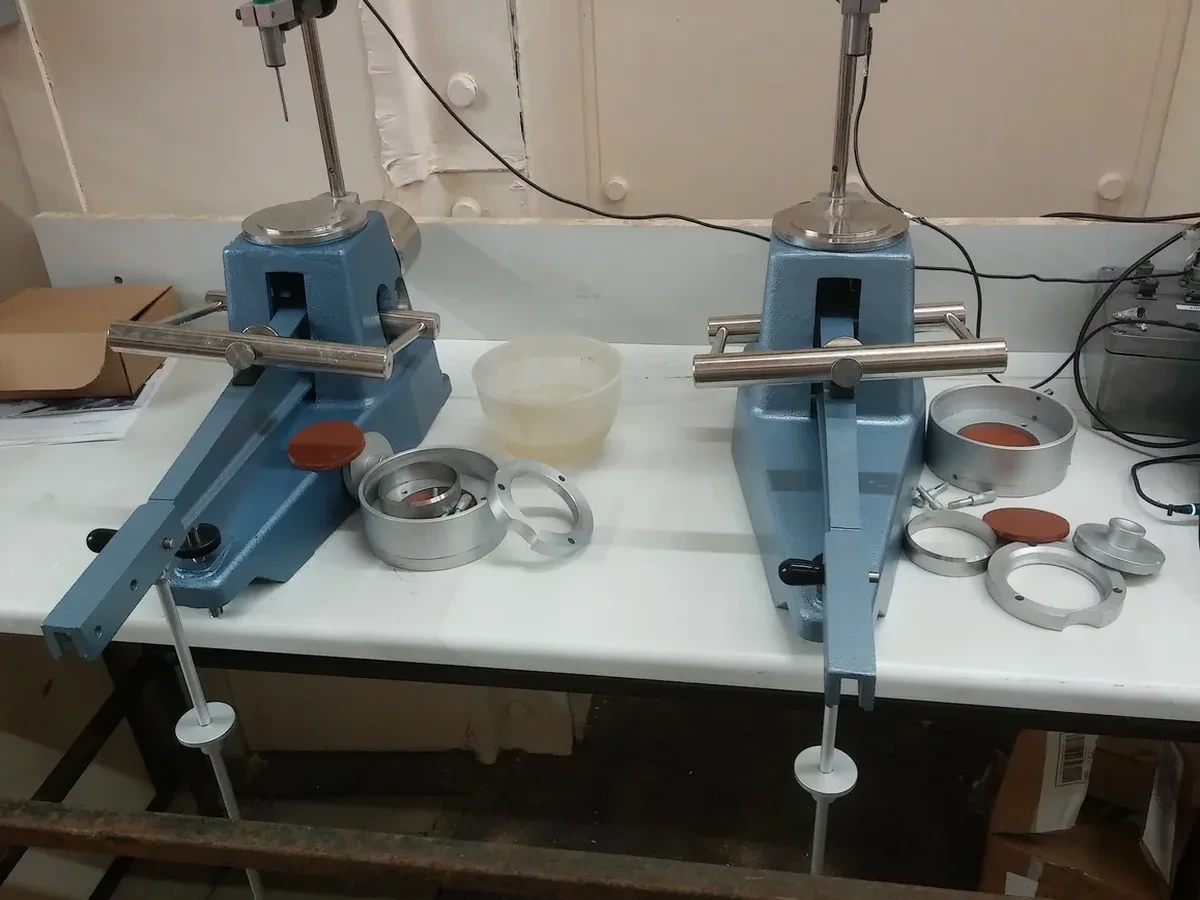
Our primary method follows ASTM D4318 which specifies the Casagrande cup—a brass cup dropped from a 10 mm height onto a hard rubber base, with the liquid limit defined as the moisture content at which 25 blows close a standard groove. We also maintain a fall cone apparatus (BS 1377) for projects with international stakeholders. The fall cone test uses a 30-degree cone penetrating 20 mm into a soil pat, and it generally produces slightly lower liquid limit values by 2 to 4 points compared to the Casagrande method for the same clay. We report the method used on every certificate.
How much does Atterberg limits testing cost in Sioux Falls?
For a standard Atterberg limits determination (liquid limit, plastic limit, and plasticity index) on a single sample, testing ranges from US$70 to US$90. Projects requiring multiple samples—common for larger commercial sites where we test at several depths—typically benefit from volume pricing. The cost includes sample preparation, triplicate plastic limit determinations, data reduction, and the signed report with USCS and AASHTO classifications.
Why does my geotechnical report classify the same soil as CL by USCS but A-6 by AASHTO?
This is a common point of confusion and it comes down to the classification logic. The USCS (ASTM D2487) considers the liquid limit and plasticity index plotted on the Casagrande plasticity chart, while the AASHTO system (AASHTO M 145) uses the liquid limit, plasticity index, and the percentage passing the No. 200 sieve in a group index formula. A soil with LL of 38 and PI of 15 with 55% passing No. 200 falls into CL under USCS but A-6 under AASHTO because the AASHTO system weights the fines percentage more heavily. Both classifications are correct—they simply serve different engineering purposes: USCS for general foundation engineering, AASHTO for pavement subgrade evaluation.
Can Atterberg limits be performed on soil samples that have dried out during transport?
Per ASTM D4318, the liquid and plastic limit tests must be performed on soil that has not been oven-dried before testing, because drying can irreversibly alter the clay mineral structure. For Sioux Falls glacial clays containing smectite, oven-drying can reduce the liquid limit by 5 to 10 points, leading to an artificially low PI and a potentially unconservative classification. We instruct field crews to ship samples in sealed, moisture-retaining containers and we note the sample condition upon receipt. If a sample arrives dry, we flag it on the report and recommend re-sampling if the material is suspected to be highly plastic.
What is the typical plasticity index range for soils in the Sioux Falls area, and what does it mean for foundation design?
Based on our database of several hundred samples from Minnehaha County, the plasticity index for the near-surface glacial till typically ranges from 10 to 25, classifying most material as CL (lean clay). However, the alluvial deposits along the Big Sioux River corridor frequently yield PI values between 25 and 40, classifying as CH (fat clay). A PI above 25 in this region correlates strongly with moderate to high shrink-swell potential, which necessitates either deeper footing embedment to reach consistent moisture zones, removal and replacement with engineered fill, or a structural floor system isolated from the expansive subgrade. For slabs-on-grade in these soils, we typically recommend a minimum 4-inch capillary break of clean sand and a vapor barrier, with thickened edges at the perimeter.